
Detail Cantuman
Advanced Search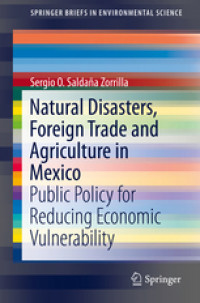
Text
Natural Disasters, Foreign Trade and Agriculture in Mexico Public Policy for Reducing Economic Vulnerability
- Bagikan:


The increasing frequency and economic losses from natural disasters within the
framework of decreasing agricultural prices and trade liberalization is becoming
crucial in increasing poverty in the Mexican rural economy. During the past two
decades, the governmental withdrawal from supporting the agricultural sector with
investments in physical, fi nancial and logistic instruments continues to stress agricultural
livelihoods,
as current private
mechanisms have
not replaced them effectively.
It has contributed
to making the agricultural sector particularly vulnerable to
a
number of hazards as it has weakened
economic agents’
response and impeded
assets
accumulation. This
book identifi
es economic vulnerability to natural and economic
hazards in order to assess public and private
coping capacity,
and provides
a
conceptual
framework
and economic theory that supports the overall
approach and
employed
methodologies. It is based on quantitative
and qualitative
research methods,
and makes
use of econometric analysis and stakeholders’
views
aimed at fi
nding
feasible solutions. Further,
this book offers
a spatial model that can support
policy-decision-making
for the creation of differential
investments
in productive
infrastructure, as well as fi nancial instruments to reduce current vulnerability and
poverty throughout the national territory.
During the past three decades, over 80% of total economic losses from weather-
related disasters occurred in the agricultural sector. In the same period, mean
weighted agricultural prices have decreased over 50% in real terms, and since 1996
a trade defi cit has persisted in this sector. Currently, insuffi cient credit access, low
coverage of crop insurance, as well as a near lack of investments to expand irrigation
and further productive
infrastructure, is sharpening the vulnerability of rural
livelihoods.
These
facts
explain
why this sector produces only 4% of the GDP
despite
employing
over
20% of the national workforce.
These
facts
undermine
farmers’
expectations
of future incomes within the community,
stimulating rural-
urban
out migration, which usually cannot be absorbed by the urban economy in
light
of the modest industrial dynamism of recent years. This
leads to enlargement
of
informal sectors in large
cities and migratory fl
ows
to abroad, among others.
Ketersediaan
Tidak ada salinan data
Informasi Detil
| Judul Seri |
-
|
|---|---|
| No. Panggil |
-
|
| Penerbit | springer : USA., 2015 |
| Deskripsi Fisik |
-
|
| Bahasa |
English
|
| ISBN/ISSN |
978-3-319-17359-7
|
| Klasifikasi |
NONE
|
| Tipe Isi |
-
|
| Tipe Media |
-
|
|---|---|
| Tipe Pembawa |
-
|
| Edisi |
-
|
| Subyek | |
| Info Detil Spesifik |
-
|
| Pernyataan Tanggungjawab |
-
|
Versi lain/terkait
Tidak tersedia versi lain