
Detail Cantuman
Advanced Search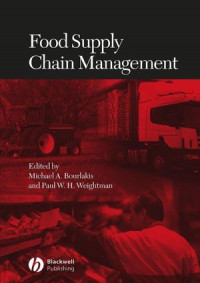
Text
Food Supply Chain Management
- Bagikan:


The book follows a ‘farm to fork’ structure. Each chapter starts with aims and an
introduction, and concludes with study questions that students in particular may
find useful. The editors introduce the food chain environment, setting the scene by
describing its major parameters and descriptors. Consumer satisfaction is the main
objective of every chain, and two chapters by David Marshall, Sharron Kuznesof
and Mary Brennan relate to this. They discuss, among other things, the product
choice process, purchasing behaviour and aspects of perceptions of risk concerning
food safety. The procurement function is introduced in a further chapter by Johanne
Allinson.
Aspects of crop and livestock production are addressed by Stephen Wilcockson
and David Harvey. Their chapters illustrate the critical role of agriculture and primary
producer within the food supply chain that has been neglected by many books.
Food manufacturing, the processors, assemblers and preparers of near ready or
table ready food are described by David Hughes, while wholesalers, retailers and
caterers are discussed by John Dawson. Networks and alliances between links in
the food chain are illustrated by Rachel Duffy and Andrew Fearne, and Mark
Francis describes new product development and the use of information technology
by Tesco, the UK’s leading food retailer.
In Chapter 11, Alan McKinnon stresses the pivotal role of third party logistics
firms in the modern food supply chain, while temperature-controlled supply chains
are addressed by David Smith and Leigh Sparks in the following chapter.
Chapter 13 has been written by a research team led by Carlo Leifert and contributes
to our understanding of the organic food supply chain, which is based on a
traditional
way of growing crops without the support of modern fertilisers, herbicides
and pesticides. Following that, James Stock discusses the US food supply
chain,
since many of the innovations to the UK and European supply chains (e.g.
efficient
consumer response) originated on the west side of the Atlantic.
In the last chapter, Costantine and Michael Bourlakis provide a synoptic view of
the trends within the food supply chain’s dynamic system and the likely direction of
its future management.
It is our aim to promote knowledge and understanding of the UK food supply
chain; however, we anticipate that the book will prove useful to readers based in
other countries in Europe and around the world. We are delighted to be able to
include knowledge and expertise from contributors based primarily in leading UK
universities. Many of the contributors are currently working at the University of
Newcastle upon Tyne, or are either graduates or former staff members. This is
hardly surprising, since Newcastle was the first English university to introduce a
Chair of Agriculture, in 1892, and the first UK university to introduce a professor-
ship in food marketing in 1963.
The book follows a ‘farm to fork’ structure. Each chapter starts with aims and an
introduction, and concludes with study questions that students in particular may
find useful. The editors introduce the food chain environment, setting the scene by
describing its major parameters and descriptors. Consumer satisfaction is the main
objective of every chain, and two chapters by David Marshall, Sharron Kuznesof
and Mary Brennan relate to this. They discuss, among other things, the product
choice process, purchasing behaviour and aspects of perceptions of risk concerning
food safety. The procurement function is introduced in a further chapter by Johanne
Allinson.
Aspects of crop and livestock production are addressed by Stephen Wilcockson
and David Harvey. Their chapters illustrate the critical role of agriculture and primary
producer within the food supply chain that has been neglected by many books.
Food manufacturing, the processors, assemblers and preparers of near ready or
table ready food are described by David Hughes, while wholesalers, retailers and
caterers are discussed by John Dawson. Networks and alliances between links in
the food chain are illustrated by Rachel Duffy and Andrew Fearne, and Mark
Francis describes new product development and the use of information technology
by Tesco, the UK’s leading food retailer.
In Chapter 11, Alan McKinnon stresses the pivotal role of third party logistics
firms in the modern food supply chain, while temperature-controlled supply chains
are addressed by David Smith and Leigh Sparks in the following chapter.
Chapter 13 has been written by a research team led by Carlo Leifert and contributes
to our understanding of the organic food supply chain, which is based on a
traditional
way of growing crops without the support of modern fertilisers, herbicides
and pesticides. Following that, James Stock discusses the US food supply
chain,
since many of the innovations to the UK and European supply chains (e.g.
efficient
consumer response) originated on the west side of the Atlantic.
In the last chapter, Costantine and Michael Bourlakis provide a synoptic view of
the trends within the food supply chain’s dynamic system and the likely direction of
its future management.
It is our aim to promote knowledge and understanding of the UK food supply
chain; however, we anticipate that the book will prove useful to readers based in
other countries in Europe and around the world. We are delighted to be able to
include knowledge and expertise from contributors based primarily in leading UK
universities. Many of the contributors are currently working at the University of
Newcastle upon Tyne, or are either graduates or former staff members. This is
hardly surprising, since Newcastle was the first English university to introduce a
Chair of Agriculture, in 1892, and the first UK university to introduce a professor-
ship in food marketing in 1963.
Ketersediaan
Tidak ada salinan data
Informasi Detil
| Judul Seri |
-
|
|---|---|
| No. Panggil |
-
|
| Penerbit | Blackwell Publishing Ltd : USA., 2004 |
| Deskripsi Fisik |
-
|
| Bahasa |
English
|
| ISBN/ISSN |
1-4051-0168-7
|
| Klasifikasi |
NONE
|
| Tipe Isi |
-
|
| Tipe Media |
-
|
|---|---|
| Tipe Pembawa |
-
|
| Edisi |
1
|
| Subyek | |
| Info Detil Spesifik |
-
|
| Pernyataan Tanggungjawab |
-
|
Versi lain/terkait
Tidak tersedia versi lain