
Detail Cantuman
Advanced Search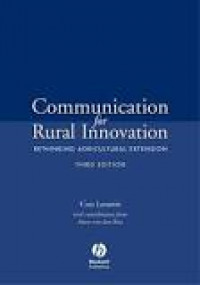
Text
Communication for Rural Innovation Rethinking Agricultural Extension
- Bagikan:


This book provides a follow-up for Van den Ban and Hawkins’ classic Agricultural
Extension (1988, 1996), of which some 35 000 copies have been printed in 10 languages
1
. It does so in several ways.
First, the book attemps to catch up with recent thinking about the relationship
between communication and change. The origins of Van den Ban and Hawkins’ book
can be traced back to the 1970s, which was the period in which the first (Dutch)
edition of the book was compiled (Van den Ban, 1974). Since then, the practice and
theory of extension and development communication have changed fundamentally.
Although many efforts were made to incorporate new ideas into later editions, we
feel that it is now time for a totally new book as we can no longer do justice to the
changes in extension thinking by merely adding to or adapting a pre-existing text.
In this new book we have maintained and adapted those insights and conceptual
models which are still of value today, but at the same time we have incorporated a
variety of new ideas, angles and modes of thinking, some of which derive from
disciplines that did not feature much in extension discourses of the past. The product
of our efforts, we hope, is a book that is ready for the 21st century, and will help to
shape and inspire new forms of communicative intervention.
Secondly, the new book provides a follow-up in that it aims at a slightly different
audience from the book Agricultural Extension. The original book was primarily
aimed at practitioners in classical agricultural extension organisations. However,
since the 1980s, the landscape of organisations that apply communicative strategies
to foster change and development in agriculture and resource management has become
much more varied. In this context, we want this new volume to offer inspiration to
communication professionals who would never think of themselves as ‘extensionists’.
Moreover, since the 1980s, a large number of practical handbooks have been published
on extension, development communication, participation, etc. (e.g. Blackburn,
1994;
Pretty et al., 1995; Swanson et al., 1997). We do not want to repeat what is
already
widely available. Thus, in this book we tend to discuss methods and methodological
issues in the context of wider conceptual debates. We pay relatively more
attention
to novel (e.g. internet-based) methods and to new ideas regarding the
management
of interactive processes. In conclusion, this book is aimed in particular
at
those who function in the higher echelons of public, private and non-governmental
organisations that use communication in order to facilitate change in agriculture and
resource management. Here we think, for example, of process facilitators, communication
division
staff, knowledge managers,
training officers, consultants,
policy
makers,
change managers and – last but not least – extension (and research!) managers or
Ketersediaan
Tidak ada salinan data
Informasi Detil
| Judul Seri |
-
|
|---|---|
| No. Panggil |
-
|
| Penerbit | Blackwell Science Ltd : U.K., 2004 |
| Deskripsi Fisik |
-
|
| Bahasa |
English
|
| ISBN/ISSN |
0–632–05249–X
|
| Klasifikasi |
NONE
|
| Tipe Isi |
-
|
| Tipe Media |
-
|
|---|---|
| Tipe Pembawa |
-
|
| Edisi |
3
|
| Subyek | |
| Info Detil Spesifik |
-
|
| Pernyataan Tanggungjawab |
-
|
Versi lain/terkait
Tidak tersedia versi lain