
Detail Cantuman
Advanced Search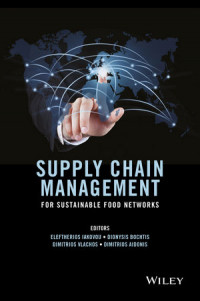
Text
Supply Chain Management for Sustainable Food Networks
- Bagikan:


The agrifood industry is a sector of significant economic and political significance.
It is one of the most regulated and protected sectors with significant implications for
sustainability such as the fulfillment of human needs, the support of employment and
economic growth, and its impact on the natural environment. According to the
European Commission, the food and drink sector contributes to some 23% of global
resource use, 18% of greenhouse gas emissions, and 31% of acidifying emissions.
Growing environmental, social and ethical concerns and increased awareness of the
effects of food production and consumption on the natural environment have led to
increased pressure by consumer organizations, environmental advocacy groups,
policy‐makers, and several consumer groups on agrifood companies to deal with
social and environmental issues related to their supply chains within product lifecycles,
from “farm
to fork.”
The agrifood industry is expected to grow in the next couple of years after a long
period of recession. To that end the industry is facing new challenges that arise from:
1. New consumer trends.
2. The need to comply with stricter and often non‐harmonized national regulatory
interventions regarding product safety, quality and traceability.
3. Increased sources of risk throughout its supply chains.
This book was motivated by a three‐year leading research project (2012–2015) that
was funded by the European Union (EU). Specifically, the Green‐AgriChains
Project has received funding from the EU’s Seventh Framework Programme (FP7‐
REGPOT‐2012‐2013‐1 under Grant Agreement No. 316167) and it involved eight
leading EU universities along with four business clusters. To that effect, the gracious
support of the European Commission is gratefully acknowledged.
This book intends to provide a holistic, up‐to‐date, interdisciplinary framework
for designing and operating sustainable supply chains for agrifood products and it
intends to add value to both practitioners and academics alike. the aim is to present sustainable practices that are unique for agriculture (such as organic products or
precision farming), as well as practices that already have been implemented in other
industrial sectors [such as transportation emissions control or corporate social
responsibility (CSR)]. All book chapters include decision‐making procedures and
methodologies, most of which are quantitative. Even though we do discuss the most
emerging state‐of‐the‐art relevant technologies, our focus is more on the managerial
dimension of the examined policies.
Ketersediaan
Tidak ada salinan data
Informasi Detil
| Judul Seri |
-
|
|---|---|
| No. Panggil |
-
|
| Penerbit | John Wiley & Sons, Ltd : U.K., 2016 |
| Deskripsi Fisik |
-
|
| Bahasa |
English
|
| ISBN/ISSN |
9781118930755
|
| Klasifikasi |
NONE
|
| Tipe Isi |
-
|
| Tipe Media |
-
|
|---|---|
| Tipe Pembawa |
-
|
| Edisi |
1
|
| Subyek | |
| Info Detil Spesifik |
-
|
| Pernyataan Tanggungjawab |
-
|
Versi lain/terkait
Tidak tersedia versi lain